
Read COAs Right: Peptide Glossary for Researchers

A peptide is a short chain of amino acids joined by peptide bonds, generally recognized as spanning 2 to 50 residues before the molecule is more accurately called a polypeptide or protein. Every entry in this glossary treats peptides strictly as research compounds with no dosing, administration, or reconstitution guidance included. For the practical side of vetting a compound once you know its name, skip ahead to the sections on Certificates of Analysis and supplier evaluation.
TL;DR:
Batch-specific Certificates of Analysis with verified purity and identity are the most reliable indicators of peptide quality, not just high purity percentages.
Scientific classification of peptides depends on length, structure, origin, and function, affecting stability and experimental design considerations.
Many research peptides are synthesized via solid-phase methods, with their verification relying heavily on chromatography and mass spectrometry data.
Peptides marketed as research compounds are not approved for human consumption and lack the safety and efficacy evaluations required for FDA-approved medicines.
Reliable supplier documentation should include batch traceability, validated analytical methods, and clear separation of research use only claims from therapeutic claims.
Table of Contents
What Do Amino Acid, Peptide Bond, and Protein Actually Mean?
Every peptide starts with amino acids, the building-block molecules that link together through a peptide bond, a covalent bond formed when the carboxyl group of one amino acid reacts with the amino group of another, releasing a water molecule. The IUPAC Gold Book defines peptides formally as amides derived from two or more amino carboxylic acids, typically alpha-amino acids, chained in this exact fashion.
Chain length is where terminology gets murky, and researchers should know there’s no single legislated cutoff:
Peptide: commonly 2 to 50 amino acid residues.
Polypeptide: a longer, unbranched chain of amino acids, often used interchangeably with “peptide” at the upper end of that range.
Protein: generally applied once a chain exceeds roughly 100 residues or reaches a molecular mass near 10,000 Daltons, frequently folded into a functional three-dimensional structure.
Every peptide chain also has direction. The free amino group end is the N-terminus; the free carboxyl group end is the C-terminus. Sequence data is always written N-terminus to C-terminus, so getting this backward will throw off how you read any published structure or synthesis record.
How Are Peptides Classified by Structure and Function?
Classification systems in peptide literature stack on top of each other, and knowing which one a paper or supplier sheet is using matters for interpreting the data correctly. Researchers sort peptides along four independent axes:
By length, using numeric prefixes borrowed from organic chemistry, dipeptide (two residues), tripeptide (three), and oligopeptide (a loosely defined short chain, often under 20).
By structure, distinguishing linear peptides from cyclic peptides, where the backbone forms a closed loop, and lipopeptides, which carry an attached lipid tail that changes membrane permeability.
By origin, separating endogenous peptides (produced naturally in an organism), synthetic peptides manufactured in a laboratory, and exogenous peptides introduced from an outside source for experimental purposes.
By function, grouping peptides as hormones, neuropeptides, antimicrobial peptides, or signaling molecules, a scheme Britannica’s peptide overview also uses to organize the biology.
Structural class often dictates experimental design directly. A cyclic peptide resists enzymatic breakdown better than its linear counterpart, which changes how long you can expect a sample to remain stable in an assay.
What Are Some Commonly Discussed Research Peptides?
Names circulating in peptide research literature and supplier catalogs vary widely in how much human evidence backs them, and this glossary lists them as neutral identifiers, not recommendations for any particular use.
BPC-157: a synthetic peptide fragment studied in preclinical models, sold strictly as a research compound.
TB-500 (Thymosin Beta-4): a peptide fragment associated with cellular studies, also distributed research-use only.
GHK-Cu: a copper-binding tripeptide examined in laboratory settings for its biochemical properties.
IGF-1 LR3: a modified analog of insulin-like growth factor 1, used exclusively in research contexts.
Tirzepatide: a dual GIP/GLP-1 receptor agonist that is an FDA-approved prescription medicine, not a research-use compound, cited here for contrast.
Many peptides discussed in online forums and supplier listings, unlike tirzepatide, have never been through controlled human trials. Treat any human-outcome claim attached to an RUO compound with real skepticism until a primary source backs it.
How Are Research Peptides Synthesized and Verified?
Most research peptides are built using solid-phase peptide synthesis (SPPS), a method where amino acids are added one at a time to a growing chain anchored to an insoluble resin bead. SPPS became the laboratory standard because it allows precise control over sequence order and makes purification more manageable than older solution-phase methods.
Verifying what actually came off that resin requires two distinct analytical techniques. High-performance liquid chromatography (HPLC) separates a sample and measures purity, while mass spectrometry (MS) confirms molecular identity by matching observed mass to the expected sequence. Together they form the backbone of any credible Certificate of Analysis (COA).
A COA worth trusting typically includes:
A batch-specific lot number tied to that exact vial, not a generic template.
Purity percentage generated via HPLC.
Identity confirmation via mass spectrometry, often with the observed mass listed alongside the theoretical value.
The retention time and analytical method used, so the test is reproducible.
Identification of the testing laboratory itself, not just the seller’s internal claim.
Pro Tip: Cross-check the retention time and mass on a COA against the peptide’s published molecular weight before you trust the purity number. A high purity percentage on the wrong molecule is not a purity result, it’s a labeling error.
Research-grade documentation like this differs meaningfully from cGMP (current Good Manufacturing Practice) documentation, which applies to pharmaceutical-grade production intended for human dosing and carries far heavier regulatory oversight.
Why Do Some Peptides Degrade Faster Than Others?
Linear peptides are vulnerable to proteases, enzymes that cleave peptide bonds, which limits how long a sample stays intact even under proper storage. Chemists counter this with a handful of well-studied modifications: cyclization, where the chain forms a closed loop that sterically blocks enzyme access; terminal protection, capping the N- or C-terminus to prevent exopeptidase attack; amino-acid substitutions that swap a vulnerable residue for a protease-resistant analog; and PEGylation, attaching polyethylene glycol chains to slow clearance and shield the peptide from degradation.
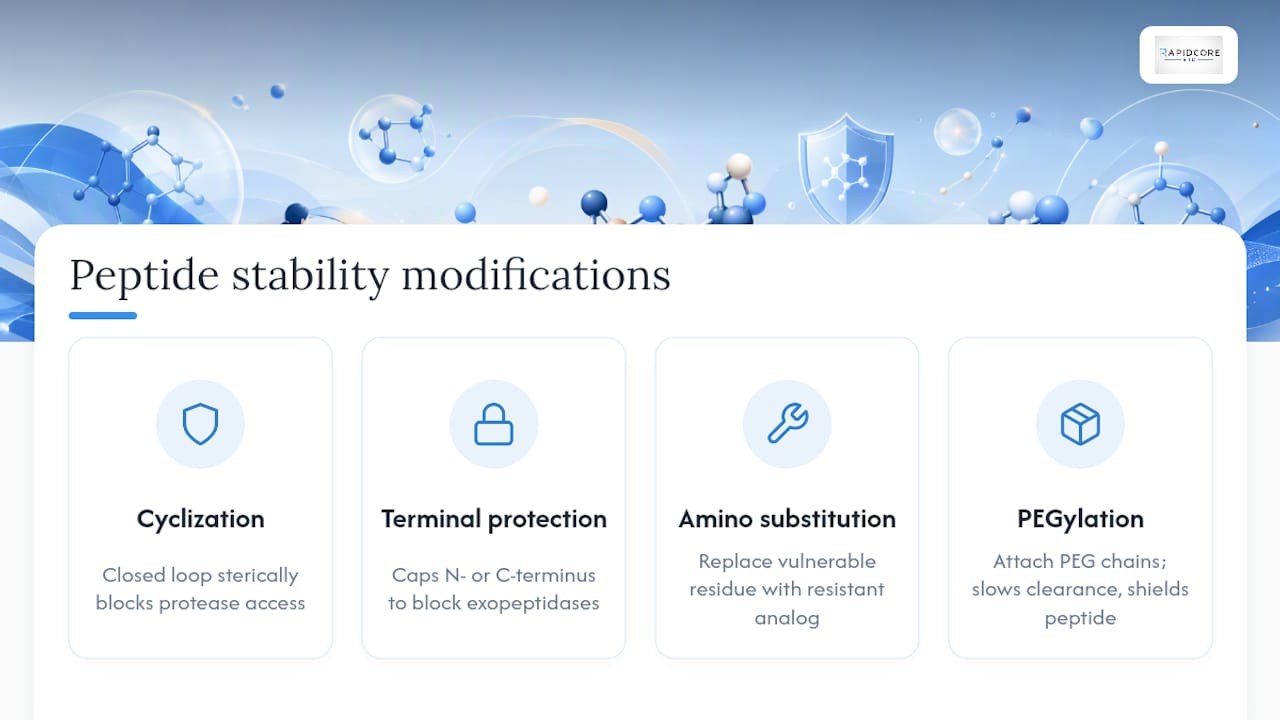
A peer-reviewed review of peptide stabilization strategies confirms cyclized and terminally protected peptides consistently show improved protease resistance over linear analogs. In practice, that means an assay measuring peptide activity over 48 hours could show a stable signal for a cyclized version while the linear form degrades to background noise by hour six, an outcome that has nothing to do with the biology being tested and everything to do with molecular stability.
Is a Research Peptide the Same as an FDA-Approved Medicine?
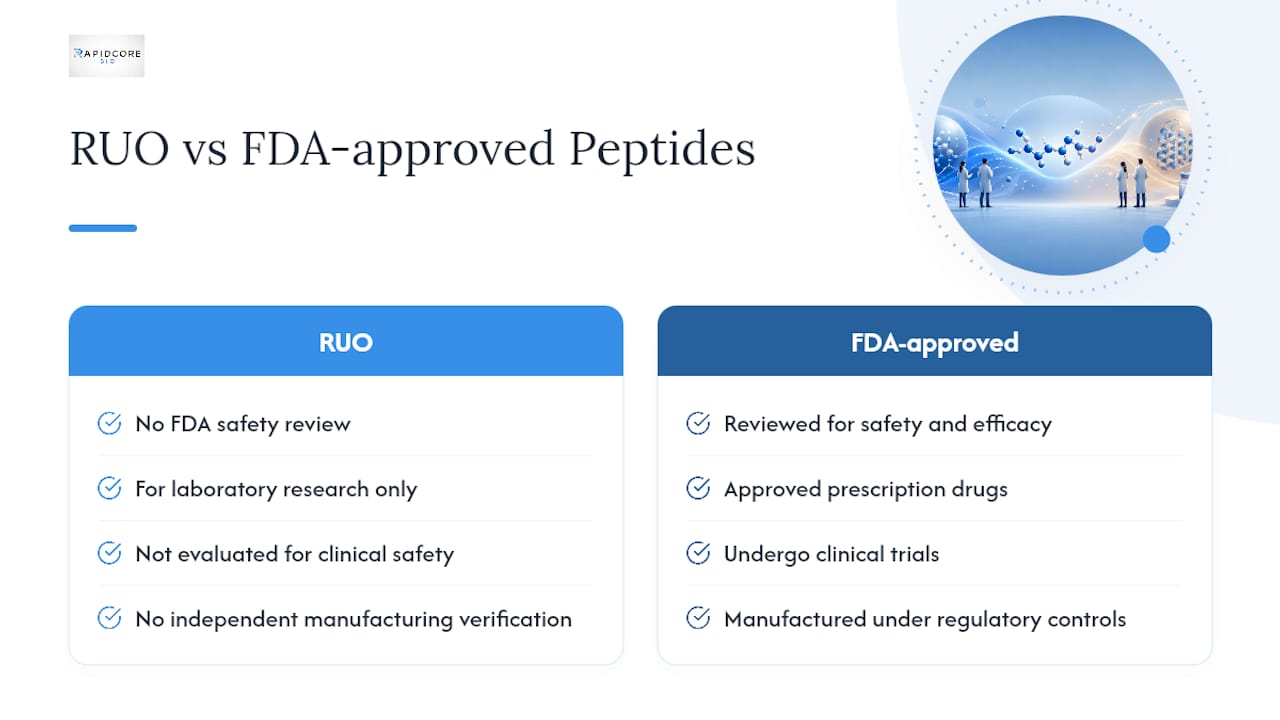
Research-use-only compounds have not been reviewed by the FDA for safety or efficacy in humans, while medicines like semaglutide and tirzepatide are approved prescription drugs subject to full regulatory oversight.
RUO (research use only) is a legal labeling category, not a purity grade. It signals that a compound is intended solely for laboratory research, not for human or animal consumption, and that no regulatory body has evaluated it for clinical safety. Healthline’s peptide safety guide draws the contrast directly: FDA-approved peptide medicines, tirzepatide among them, go through clinical trials and manufacturing controls that RUO compounds simply never see.
That gap matters for safety, too. Harvard Health warns that many peptides marketed online outside clinical channels lack the human-trial evidence needed to establish safety, and contamination risk rises when manufacturing isn’t independently verified. Regulatory status also constrains what a supplier can legally claim; RUO labeling and therapeutic marketing language are not supposed to appear on the same product listing.
How Do You Vet a Peptide Supplier’s Quality Signals?
A supplier’s documentation tells you more than its marketing copy ever will. Before treating any listing as trustworthy, confirm the basics: a batch-specific COA showing both HPLC purity and mass spectrometry identity, a named and identifiable testing laboratory, a complete description of the analytical method used, and clear RUO labeling with no therapeutic claims attached.
Red flags to watch for:
Therapeutic or dosing claims sitting next to an RUO label.
A COA with no batch number, meaning it could apply to any vial the seller has on hand.
Purity numbers listed with no method or retention time behind them.
A supplier that publishes batch-specific COAs with full method detail and points to independent testing rather than in-house numbers alone is showing you the kind of documentation transparency the research community should expect as standard, not a bonus feature. Rapidcorebio structures its own purity vs. reliability testing approach around exactly that principle, pairing HPLC and mass spectrometry results with clear batch traceability. For a deeper walkthrough of what each COA line item should contain, our Certificate of Analysis guide breaks it down field by field.
Where Should You Go From Here?
This glossary gives you the vocabulary to read peptide literature and supplier documentation with a critical eye, always with the research-use-only disclaimer in mind. For deeper reference material, Rapidcorebio’s research handbook expands on these terms, and our COA verification resource walks through what proper documentation looks like batch by batch.
What Does This Glossary Get Right That Others Miss?
Most peptide glossaries stop at definitions and never touch the part researchers actually struggle with: telling a legitimate compound from a poorly documented one. That’s backward. Knowing that a dipeptide has two residues is trivial compared to knowing whether the COA in front of you actually matches the vial it came with.
The conventional advice, “look for high purity percentages,” misses the point entirely. It’s a number with nothing behind it. Purity means nothing without traceable identity confirmation from mass spectrometry and a reproducible HPLC method sitting next to it.
If there’s one thing readers should prioritize, it’s this: treat documentation transparency as the primary filter, and treat purity percentage as secondary. A supplier willing to show batch-specific analytical data with named labs behind it is telling you something a marketing page never will. Everything else, including the biochemistry, only matters once that foundation checks out.
— Adrian K. Solis
Sources
Recommended
Comments