
Confirm Batch Matched Peptide Documents: RFQ Wording and Receipt Checks

The minimal document package that genuinely confirms a peptide delivery is a batch-specific certificate of analysis (COA) paired with an HPLC chromatogram tied to that same batch, plus a mass confirmation (LC-MS) when identity matters most. Every one of those documents, along with the packing list and vial label, needs to carry the same lot number. If the numbers don’t match, you don’t have proof of anything, you have paperwork.
TL;DR:
Confirm that the batch number on the COA, HPLC, LC-MS reports, vial label, and packing list match exactly for proper verification.
Request shipment documents including batch-specific COAs, HPLC chromatograms, and LC-MS data during the RFQ process to ensure proper documentation before payment.
Verify that the COA is issued by an accredited, ideally third-party, lab with relevant signatures, dates, and method identifiers for authenticity.
Immediately escalate discrepancies such as mismatched batch numbers or inconsistent chromatogram results to the supplier and request corrected documentation or third-party testing.
Choose suppliers like RapidCoreBio that publish batch-specific COAs to shorten verification time and improve confidence in material identity and purity.
Table of Contents
Document checklist: COA, HPLC, LC-MS, SDS, packing list, and specs, and what each proves
How to verify batch linkage and document authenticity quickly on receipt
How to specify documentation and timing in the RFQ and order confirmation
Discrepancies and escalation: common red flags and how to resolve them
RapidCoreBio: how supplier-published COAs and verification shorten risk and resolution
Author perspective: a short editorial note on traceability and reproducibility
How RapidCoreBio can help: COA verification and where to start
Document checklist: COA, HPLC, LC-MS, SDS, packing list, and specs, and what each proves
A shipment of research peptides should arrive with a small stack of documents, each doing a different job. Knowing what to expect keeps you from mistaking a generic spec sheet for actual batch evidence.
A batch-specific COA lists the product identity, sequence, lot or batch number, purity result, and the test methods used to get there. The ICH Q7 guideline describes exactly this: a COA should show the tests performed, the batch number, relevant dates, and authorized signatures, which is what separates a real report from a marketing sheet. The HPLC chromatogram is the visual and numerical purity readout, showing a purity percentage, a peak trace, and retention time data, and it should reference the batch it belongs to rather than sitting as a generic image. LC-MS output gives you the observed molecular mass to compare against the theoretical mass of the peptide sequence, which is the step that actually confirms identity rather than just purity.
COA: product ID, sequence, batch number, purity result, test methods used.
HPLC chromatogram: purity percentage, peak trace, retention time, linked batch reference.
LC-MS report: observed mass versus theoretical mass for identity confirmation.
SDS, spec sheet, packing list, invoice: handling hazards, target specifications versus actual batch results, and shipment contents.
A research-grade peptide shipment checklist also flags dangerous-goods paperwork when cold-chain shipping applies. Keep the spec sheet separate in your mind from the batch results: one is a target, the other is what you actually received.
How to verify batch linkage and document authenticity quickly on receipt
Verification is mostly a matching exercise, and it takes minutes once you know what to line up.
Pull the batch or lot number from the vial label, packing list, COA, HPLC report, and LC-MS report, and confirm all five match exactly.
Check the issuing lab name, analyst or reviewer signature, and the report date on each document.
Note any instrument or method identifiers (column type, mass spec model, method ID) since legitimate reports usually include them.
Determine whether the HPLC and LC-MS results came from an in-house lab or an accredited third-party laboratory, and look for accreditation marks or contact information.
Flag anything that looks like a “representative” or “typical” COA rather than one tied to the physical lot in front of you.
Pro Tip: Photograph the vial label and packing list side by side with the COA on your screen before you file anything, it takes thirty seconds and gives you a permanent audit trail.
A missing batch number, a chromatogram with no batch reference, or a report dated weeks after the shipment left the supplier are all signs worth a follow-up email before you use the material.
How to specify documentation and timing in the RFQ and order confirmation
Getting the right documents starts before you pay, not after the box arrives. Your RFQ or purchase order should state exactly what you expect and when.
Request “a batch-specific COA matching the lot to be shipped, including test methods and analyst sign-off.”
Ask for “an HPLC chromatogram generated from the final shipped lot, not a representative sample.”
Confirm “LC-MS availability for identity confirmation” if your protocol depends on molecular identity, not just purity.
Specify whether documents arrive “before shipment, with the shipment, or via a secure document portal,” and in what format (signed PDF, with instrument metadata where possible).
A B2B procurement guide for peptide sourcing notes that third-party testing can add lead time and cost, so ask your supplier to reflect that in the proforma invoice rather than discovering it after the order is placed. It’s also worth asking directly whether the supplier will share raw chromatogram data or method notes, since some will only provide a summary unless you ask.
Receiving checks and quick in-house verification workflow
Once the shipment lands, a short receiving routine catches most problems before material goes anywhere near an experiment.
Inspect the outer packaging for damage or temperature excursion indicators before opening.
Photograph the package condition, then match the packing list and vial labels against the COA batch number.
Run a quick visual check on vial fill volume and lyophilized cake appearance against what the spec sheet describes.
If anything looks inconsistent, escalate to in-house HPLC or LC-MS reanalysis, or send a sample to a third-party lab.
Save digital copies of the COA, chromatogram, label photos, and tracking information together in one record.
If the shipment involved dry ice or cold packs, confirm the packing slip documents the cold-chain method used, since that becomes relevant if you ever need to explain a stability question later.
Discrepancies and escalation: common red flags and how to resolve them
Most documentation problems fall into a short list: no batch number on the COA, a chromatogram that doesn’t match the reported purity, or a COA that’s clearly a representative sample rather than lot-specific evidence.
Photograph the vials and packing list immediately, and save full PDF copies of every document received.
Send a written discrepancy notice within a few business days, referencing the batch number and the specific mismatch.
Ask the supplier for a corrected, batch-linked COA or a fresh chromatogram tied to the shipped lot.
If the response is unsatisfactory, request independent third-party testing and document the result against the original claim.
Method reviews consistently point out that chromatograms alone don’t confirm molecular identity, which is exactly why an unresolved LC-MS gap is worth pushing on rather than letting slide.
RapidCoreBio: how supplier-published COAs and verification shorten risk and resolution
RapidCoreBio publishes batch-specific COAs for its research peptide lines, which means the verification steps above start from a document that’s already tied to the lot you’re holding rather than a generic reference sheet. Pairing that with responsive procurement support shortens the back-and-forth when a batch number needs confirming or a chromatogram needs a second look. For a deeper walkthrough of what belongs on a COA and how to read it, RapidCoreBio’s peptide certificate of analysis guide breaks down each field.

Author perspective: a short editorial note on traceability and reproducibility
Reproducible lab work depends on knowing exactly what you put into an experiment, and that starts with a document trail tied to the physical batch, not a supplier’s average. Require COAs and chromatograms before shipment whenever possible, and keep records long enough to survive an audit or a failed replication attempt. These are research compounds intended for laboratory use only, not for human or animal consumption, and the documentation habits described here exist to support that boundary, not blur it.
— Adrian K. Solis
How RapidCoreBio can help: COA verification and where to start
If you’re placing an order and want the documentation question settled before checkout, start with the pages built for exactly that. RapidCoreBio’s research peptides category lists batch-linked compounds with COA access built into the ordering process, so you’re not chasing paperwork after the fact.
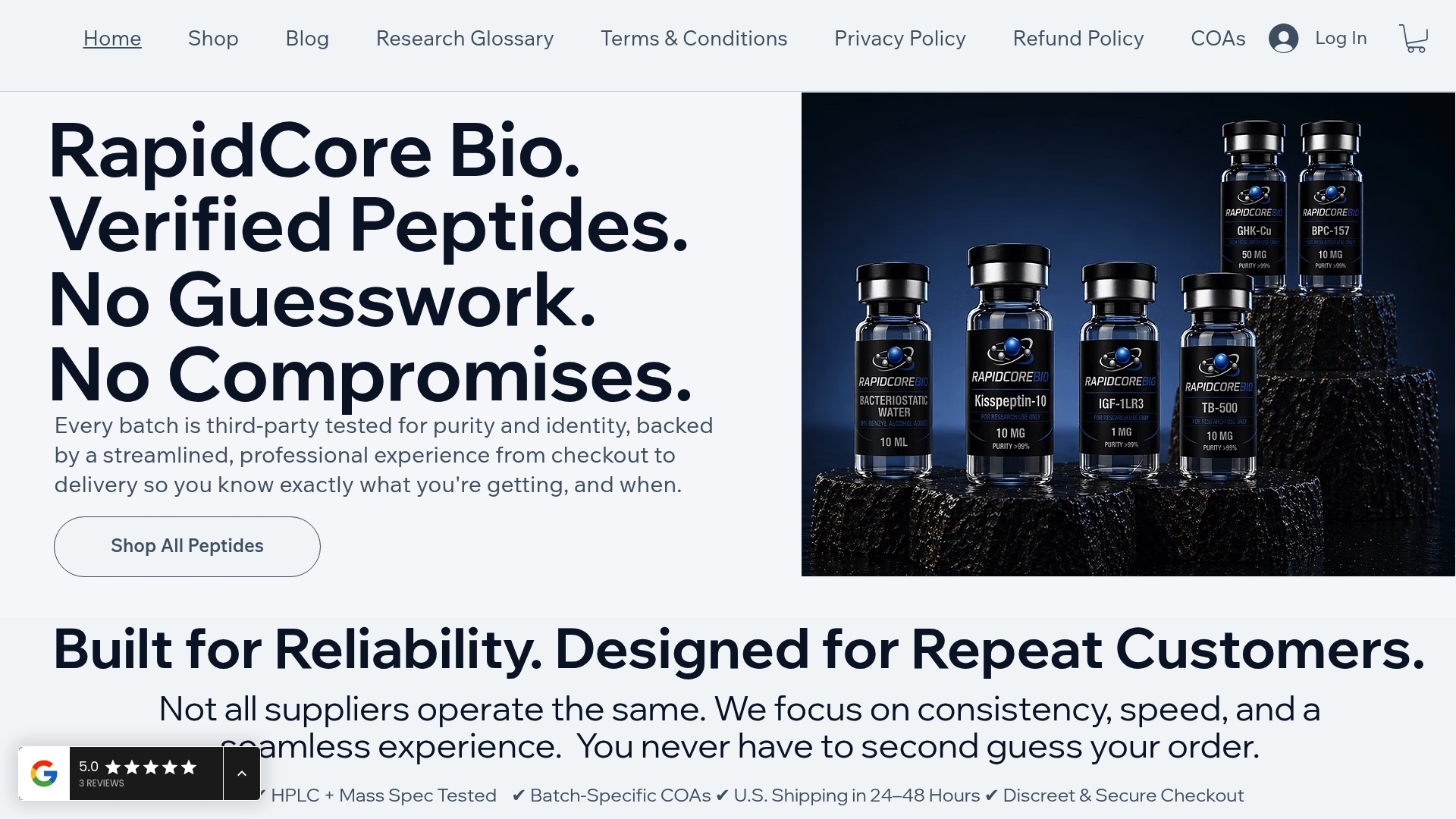
Check research peptides for batch-specific compounds with published COAs.
Browse peptide stacks when your protocol calls for a formulated combination.
Reach out through the site’s support contact for procurement questions about documentation timing or format before you order.
Sources
For the underlying documentation standards, ICH Q7 and its Q&A companion set the reference points for batch records and COA content that most credible peptide suppliers follow.
FAQ
What is a batch-specific COA and why does it matter?
A batch-specific COA lists test results, methods, and dates tied to the exact lot you received rather than a general average for the product line. Without batch linkage, a COA can’t actually prove anything about the vial in front of you, per ICH Q7 expectations for authorized batch documentation.
Does an HPLC chromatogram confirm peptide identity?
No, an HPLC chromatogram confirms purity, not molecular identity. Confirming identity typically requires an LC-MS comparison of observed mass to theoretical mass, since analytical method reviews recommend combining orthogonal techniques for a complete picture.
What should I do if the batch number on my COA doesn’t match the label?
Stop and flag it immediately, since a mismatched batch number means the document can’t be trusted to describe the material you received. Photograph the label and packing list, request a corrected batch-linked COA from the supplier, and escalate to third-party testing if the discrepancy isn’t resolved quickly.
Should I ask for documents before or after shipment?
Before shipment whenever possible, since specifying this in the RFQ avoids discovering a documentation gap after payment. A research-grade peptide shipment checklist recommends confirming HPLC and LC-MS availability at the quoting stage rather than assuming it.
Does RapidCoreBio provide batch-specific COAs?
Yes, RapidCoreBio publishes batch-specific COAs for its research peptide lines so buyers can confirm lot-level results before or with their shipment.
Recommended
Comments